Student Seminar
The Student Seminar of the Doctoral Program in Mathematical Sciences, offered by the Universidad de La Frontera, is an event organized by its students with outreach purposes and aimed at the entire university community, both undergraduate and graduate students. Through periodic talks, various topics related to mathematical research are presented in an accessible and engaging way. The speakers include students, faculty from the program, and invited guests from the UFRO or other universities. These sessions are jointly organized by the Doctoral Program and the Research Center Geometry at the Frontier.
Organizers 2026
Martín Solar – Jhony Leica
Session 1
Friday, May 29 – 11:00 a.m.
Speaker: Víctor Valdebenito, Universidad de La Frontera
Title: Jacobian varieties of curves with singularities
ABSTRACT:
Jacobian varieties associated with smooth curves play a central role in algebraic geometry, both because of their rich intrinsic structure and their connections with problems in moduli theory, complex geometry, and deformation theory. However, when the curve has singularities, the situation becomes considerably more subtle, and the so-called generalized Jacobian varieties arise naturally.
In this talk, I will introduce the construction of these generalized Jacobians and discuss how their structure reflects geometric information about the singularities of the curve. In particular, we will see how certain local invariants of the singularities are related to the algebraic and geometric structure of the generalized Jacobian.
In addition, I will comment on some applications of these constructions to the study of degenerating families of curves, compactifications of moduli spaces, and problems related to degenerations of abelian varieties. The main goal of the talk is to present geometric and modular motivations that naturally lead to several open problems in the area.
Organizers 2023
Pablo Quezada – Víctor Valdebenito
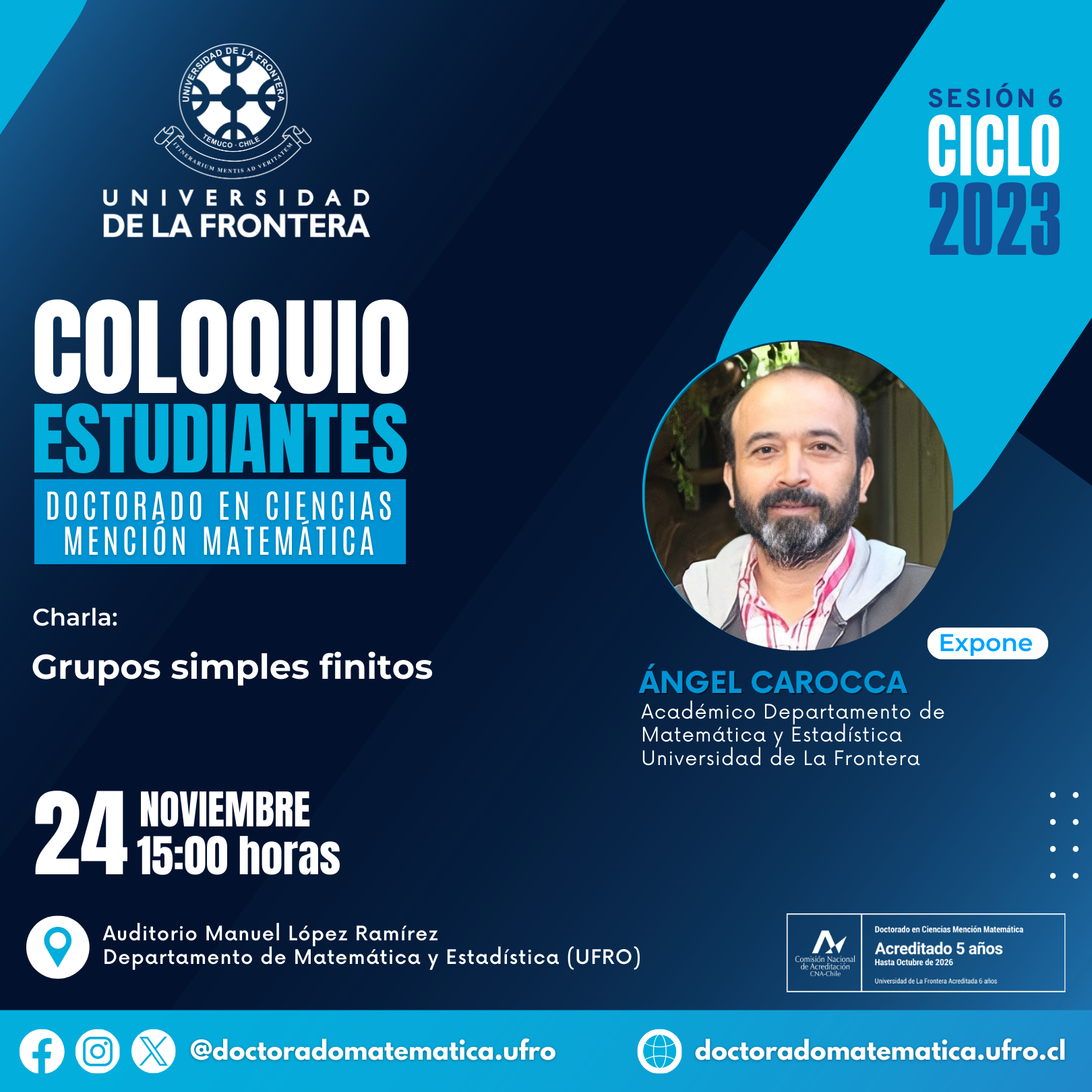
Session 6
Friday, November 24 – 3:00 p.m.
Speaker: Ángel Carocca, Universidad de La Frontera
Title: Finite simple groups
ABSTRACT:
In this talk, we will review some key aspects of the project that spanned over 110 years and ultimately led to the classification of finite simple groups.
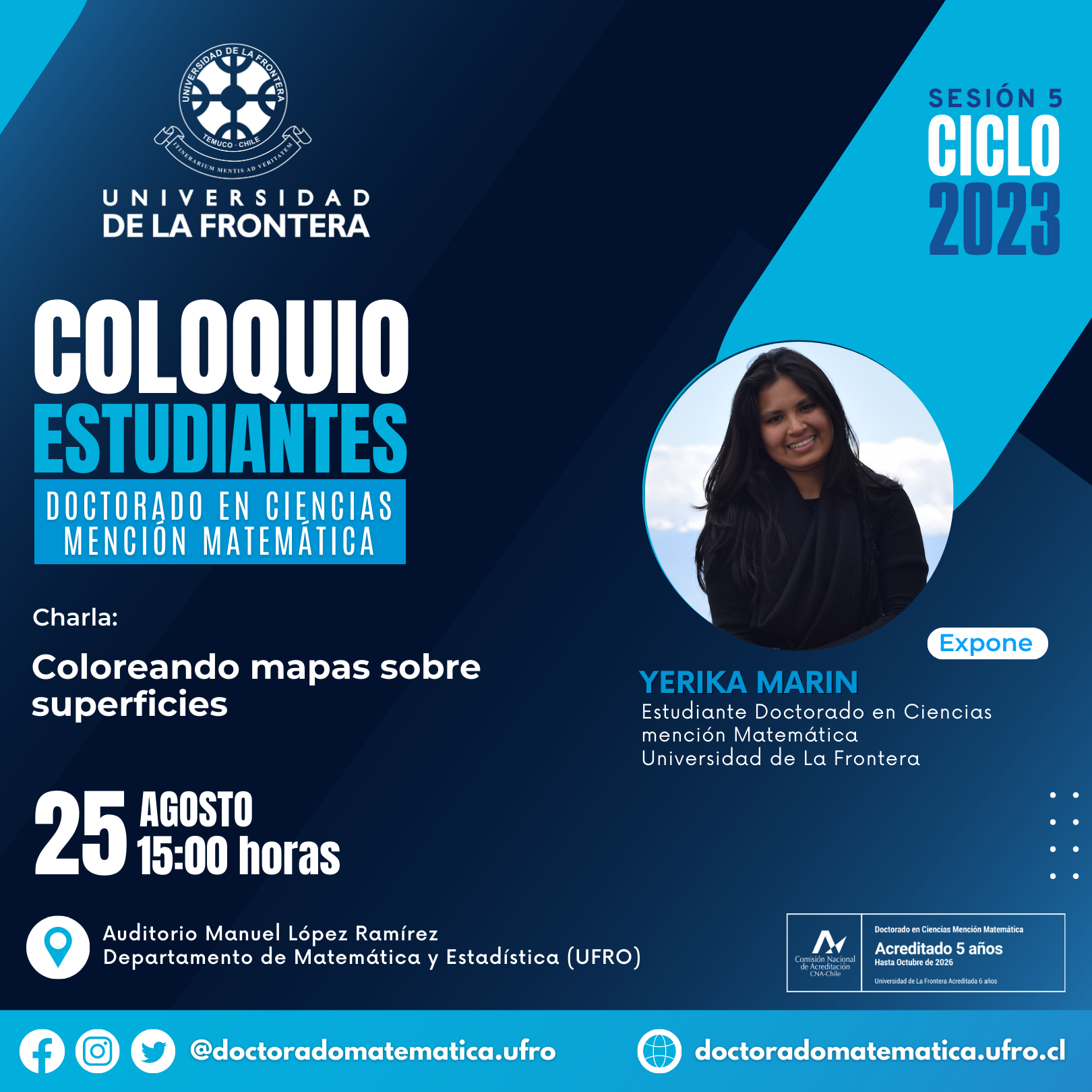
Session 5
Friday, August 25 – 3:00 p.m.
Speaker: Yerika Marín, Universidad de La Frontera
Title: Coloring maps on surfaces
ABSTRACT:
The Four Color Theorem states that four colors are sufficient to color any map on a plane or a sphere such that no adjacent regions share the same color. This problem is well-known for being simple to state but extremely difficult to prove. While it is easy to draw a map on a sphere that requires four colors, maps that reach the maximum number of colors on other surfaces are more complex. In this talk, we will outline the proof of the Five Color Theorem and present results on coloring maps on closed surfaces of genus g ≥ 1 (P. Heawood). Finally, we will show a model construction of a map on a torus with seven regions using modular origami with Sonobe units (E. Torrence).
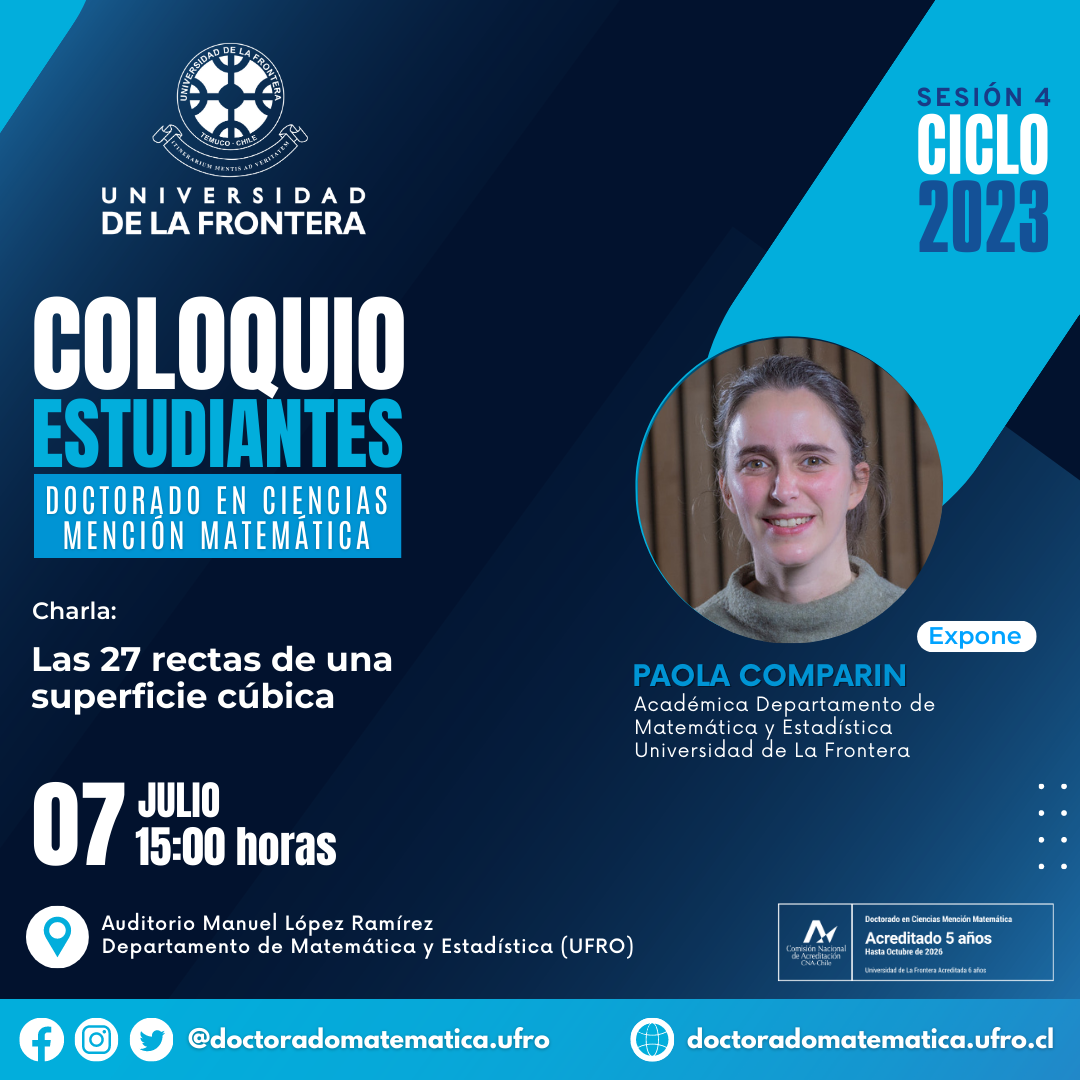
Session 4
Friday, July 7 – 3:00 p.m.
Speaker: Paola Comparin, Universidad de La Frontera
Title: The 27 lines on a cubic surface
ABSTRACT:
Wake up an algebraic geometer in the middle of the night and whisper “27”. There's a good chance they will reply, “Lines on a cubic surface.” (Ron Donagi and Roy Smith, 1901). In this talk, we will discuss the famous result that every smooth cubic surface over an algebraically closed field always contains exactly 27 lines. We will explore the basic idea behind the proof and introduce some problems in enumerative geometry.
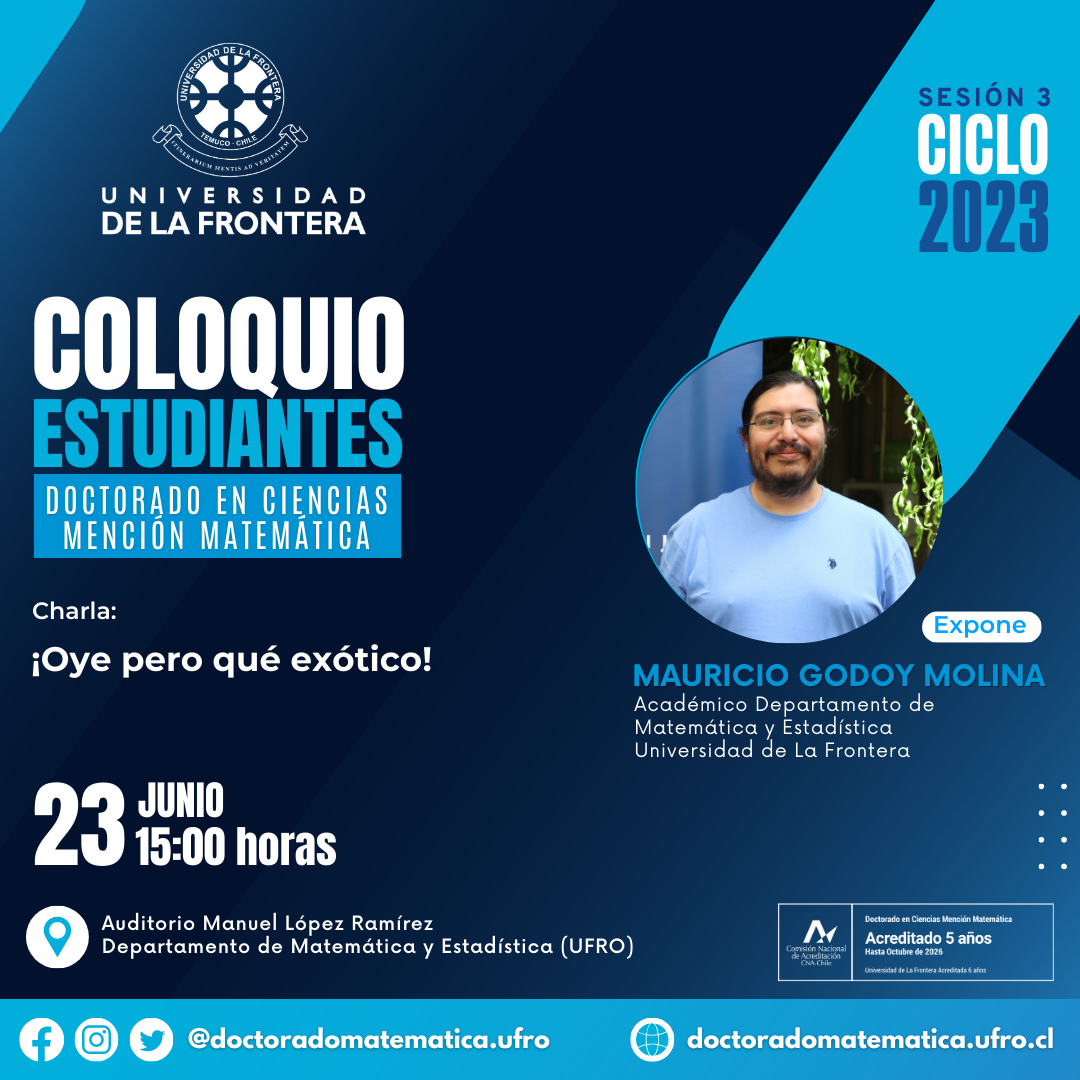
Session 3
Friday, June 23 – 3:00 p.m.
Speaker: Mauricio Godoy Molina, Universidad de La Frontera
Title: Whoa, That’s So Exotic!
ABSTRACT:
While attempting to disprove the Poincaré conjecture, Milnor, in the 1950s, constructed 7-dimensional “spheres” that geometers called exotic: they are topological spheres, but not differentiable ones. To put it provocatively, on these “spheres” the identity function f(x) = x is continuous, but not differentiable.
Later, Milnor and Kervaire realized that exotic spheres in the same dimension (for n ≤ 4) form a finite group under the operation of connected sum. Whether the 4-dimensional sphere admits exotic structures remains an open problem. In case you’re wondering: in ℝⁿ there are no exotic structures for n ≤ 4. However, Freedman, Donaldson, Gompf, and Taubes proved in the 1980s that ℝ⁴ admits uncountably many exotic structures.
In this seminar, I will explain the construction of 7-dimensional exotic spheres in some detail, especially the “sphere” of Gromoll and Meyer. With less detail, I will outline the group structure and explore a few examples in various dimensions. I will not attempt to explain exotic ℝ⁴ structures—at all.
Session 2
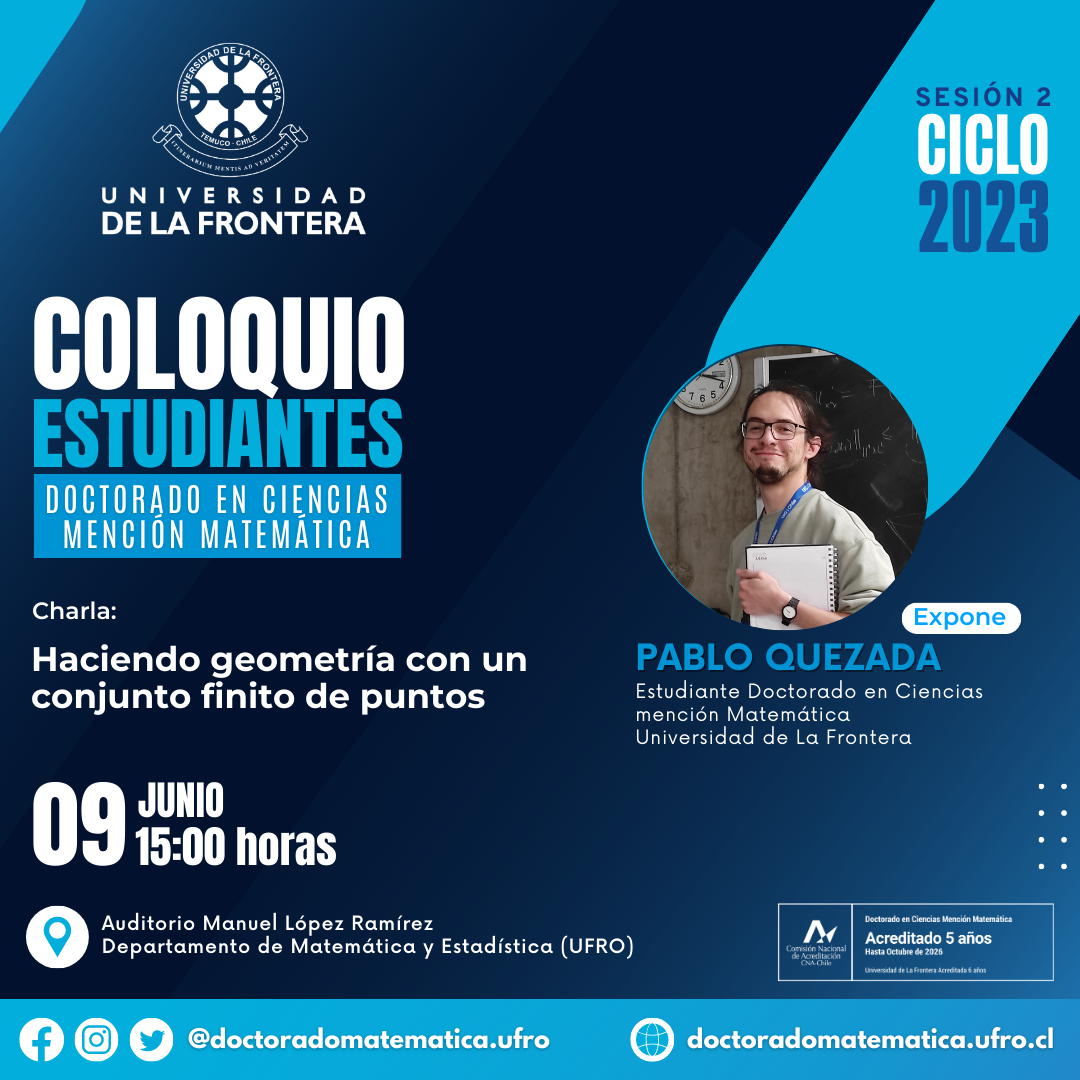
Friday, June 9 – 3:00 p.m.
Speaker: Pablo Quezada, Universidad de La Frontera
Title: Doing geometry with a finite set of points
ABSTRACT:
In this talk, we will pose the following question: Can we construct a geometry without restrictions on the number of points and lines? More specifically, can we build a geometry with only finitely many points and lines?.
We will explore the implications of this question by studying finite affine and projective planes, examining examples and their properties, and characterizing when a finite affine or projective plane admits coordinates in a field.
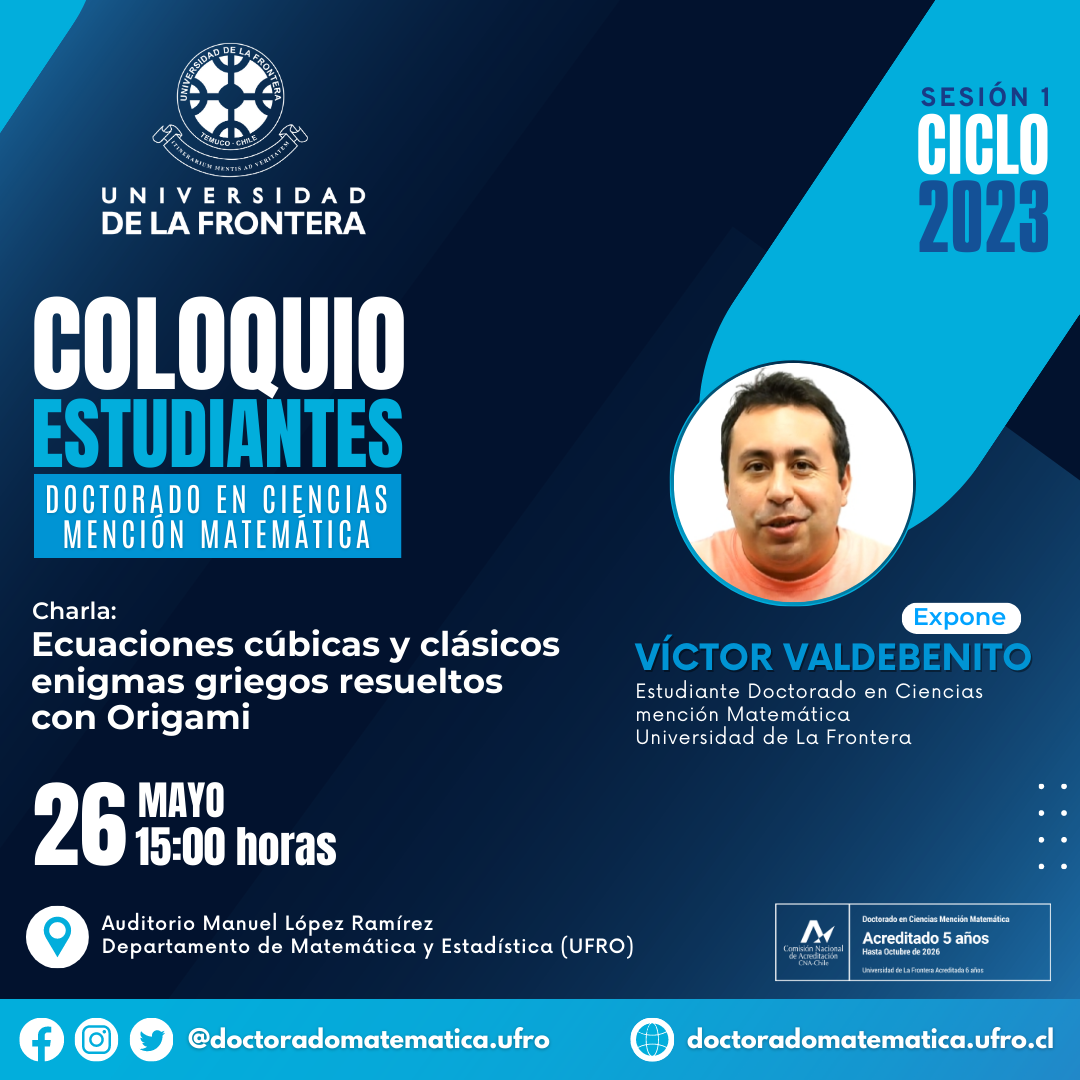
Session 1
Friday, May 26 – 3:00 p.m.
Speaker: Víctor Valdebenito, Universidad de La Frontera
Title: Cubic equations and classical greek problems solved with Origami
ABSTRACT:
This talk will introduce the construction of origami numbers, which form the smallest subfield of the complex numbers closed under square and cube roots. The idea is to use paper folding to add a construction axiom to the classical set of compass and straightedge constructible numbers.
It will be shown that, using this approach, it is possible to trisect angles and double the cube, although squaring the circle remains impossible. Additionally, a method for solving cubic equations through origami will be presented.
The main goal is to fully characterize origami numbers by studying the Galois group of their minimal polynomial over the rationals. We will also characterize the regular polygons that can be constructed using ruler, compass, and paper folding.